Wyckoff Quantitative Analysis Report - Product Code: 399935

Analysis Date Range: 2025-11-10 to 2026-01-09
Report Generation Date: 2026-01-09
Core Methodology: Wyckoff Price-Volume Principles, Quantitative Data Analysis


1. Trend Analysis and Market Phase Identification

As of 2026-01-09, the subject 399935 opened at 6754.41, closed at 6879.99, with a 5-day moving average of 6694.18, 10-day MA of 6561.96, 20-day MA of 6389.43, daily change of +1.12%, weekly change of +7.20%, monthly change of +7.20%, quarterly change of +7.20%, annual change of +7.20%.

399935 Price Trend Analysis Chart, including closing price and multiple moving averages

1.1 Price and Moving Average Relationships:

  • Data Observations:
    • November 2025: The price (closing price) experienced a significant decline, dropping from 6494 (Nov 10) to a low of 5863 (Nov 21). During this period, the price consistently traded below almost all moving averages (MA_5D, MA_10D, MA_20D, MA_30D). MA_5D and MA_10D successively fell below MA_20D and MA_30D, forming a standard bearish alignment. Although MA_60D was the lowest (approx. 6200-6380), the price also fell sharply below this long-term MA on November 21.
    • December 2025: After consolidating at low levels, the price began to rebound. On December 24th, the closing price (6418) reclaimed positions above MA_5D, MA_10D, and MA_20D, but remained pressured by MA_30D (6386) and MA_60D (6410). By December 30th, the price (6470) successfully broke above MA_60D.
    • Early January 2026: The price experienced explosive growth. The January 9th close (6880) was significantly above all MAs (MA_5D: 6694, MA_10D: 6562, MA_20D: 6389, MA_30D: 6326, MA_60D: 6378), forming a distinct bullish alignment.

1.2 Moving Average Crossover Signals and Significance:

  • • Based on the data sequence, in mid-to-late November 2025, the short-term MA (MA_5D) remained consistently below the longer-term MA (MA_20D), confirming a downtrend.
  • • The critical bullish crossover signals occurred from late December 2025 to early January 2026. For instance, MA_5D rapidly crossed above MA_20D and MA_30D in early January, followed by MA_10D, representing strong signals for trend reversal and acceleration.

1.3 Market Phase Inference (Based on Wyckoff):

  • November 2025: The market was in a post-distribution decline and panic selling phase. Prices broke below multiple support levels, with volume expanding during the decline (e.g., Nov 21), consistent with the "Selling Climax" characteristic in Wyckoff theory, although supply was not yet fully exhausted.
  • December 2025: The market entered a secondary test and accumulation phase. Prices oscillated repeatedly in a low range (5900-6200 interval). Volume contracted compared to the November peak (VOLUME_AVG_60D_RATIO dropped from 0.7 to below 0.6). However, key rebound days (e.g., Dec 1, Dec 24) were accompanied by expanding volume, indicating demand began to enter the market quietly.
  • Early January 2026 (as of Jan 9): The market clearly entered the Markup phase. Prices broke above all key MAs and prior resistance levels (e.g., 6500, 6800) on heavy volume. The rally was supported by massive turnover, indicating demand has taken full control of the market, confirming a strong uptrend.

2. Price-Volume Relationships and Supply-Demand Dynamics

As of 2026-01-09, the subject 399935 opened at 6754.41, closed at 6879.99, volume 8445504800, daily change +1.12%, volume 8445504800, 7-day average volume 6914595271.43, 7-day volume ratio 1.22.

399935 Price-Volume Relationship Line Chart and Historical Ranking Analysis

2.1 Key Price-Volume Day Analysis:

  • Heavy-Volume Decline (Supply Dominated):
    • 2025-11-21: Price plunged -4.10%, with volume surging 35.4% to 4.865 billion. VOLUME_AVG_7D_RATIO was as high as 1.16. Historical rankings show the day's AVERAGE_VOLUME_60D was the 16th highest in nearly a decade. This is a classic panic selling day with massive supply outflow.
  • Heavy-Volume Advance (Demand Dominated):
    • 2026-01-06: Price rose 1.84%, with volume skyrocketing 40.9% to 9.659 billion, marking the highest single-day volume during the analysis period. VOLUME_AVG_14D_RATIO reached 1.97 (ranking 15th in nearly a decade), and VOLUME_AVG_7D_RATIO reached 1.85 (ranking 19th). This is a clear signal of strong demand and aggressive buying by large capital, establishing the uptrend.
    • 2026-01-09: Price rose 1.12%, with volume remaining high at 8.446 billion. VOLUME_AVG_14D_RATIO was high at 1.49. Rising price with high volume indicates sustained demand.
  • Light-Volume Pullback (Temporary Demand Hesitation/Limited Supply):
    • • Multiple pullbacks in mid-to-late December (e.g., Dec 11, Dec 19) were accompanied by contracting volume (VOLUME_AVG_7D_RATIO below 1), indicating limited selling pressure during declines, characteristic of healthy profit-taking or technical corrections.

2.2 Volume Anomalies and Supply-Demand Shift:

  • • The VOLUME_GROWTH indicator shows that from January 5th, volume consecutively showed double-digit positive growth (30.1%, 40.9%, -9.9%, -18.2%, 18.5%), with the overall trading level jumping significantly.
  • • In early January, VOLUME_AVG_7D_RATIO, VOLUME_AVG_14D_RATIO, and VOLUME_AVG_21D_RATIO were all consistently above 1, reaching extreme values on January 6th. This quantitatively confirms the market shifted from a relatively balanced or demand-probing state in December to a unilateral trend dominated by strong demand in early January.

3. Volatility and Market Sentiment

As of 2026-01-09, the subject 399935 opened at 6754.41, 7-day intraday volatility 0.24, 7-day intraday volatility ratio 1.14, 7-day historical volatility 0.28, 7-day historical volatility ratio 1.19, RSI 71.02.

399935 Historical Volatility Analysis Chart and Historical Ranking Data

3.1 Volatility Levels and Changes:

  • Long-term Volatility: HIS_VOLA_60D gradually declined from 0.48 to 0.34 by January 9th over the analysis period, indicating the long-term volatility environment is stabilizing.
  • Short-term Volatility:
    • • During the November panic decline, HIS_VOLA_7D (0.375, 0.359) repeatedly approached or exceeded HIS_VOLA_60D, with HIS_VOLA_RATIO_7D_60D above 0.75, showing a sharp spike in short-term panic sentiment.
    • • Entering the January rally phase, HIS_VOLA_7D (0.279-0.295) stabilized below HIS_VOLA_60D, with HIS_VOLA_RATIO_7D_60D maintained between 0.76-0.81. This indicates that although the rally is strong, sentiment is not excessively euphoric, and volatility remains within a controlled range. PARKINSON_VOL_7D (~0.24) was also below its long-term average (PARKINSON_VOL_60D: 0.26-0.28), showing intraday volatility convergence, which is favorable for trend continuation.

3.2 Overbought/Oversold Status (RSI):

  • 2025-11-21: RSI_14 fell to 32.14, entering oversold territory. Combined with the heavy-volume price plunge, this formed an emotional extreme, providing conditions for a subsequent rebound.
  • 2026-01-09: RSI_14 rose to 71.02, entering overbought territory. However, against the backdrop of a heavy-volume advance, this typically signifies strong trend momentum rather than an immediate reversal signal. Attention should be paid to whether bearish divergence or high-volume stagnation appears subsequently.

4. Relative Strength and Momentum Performance

  • Momentum Trend Reversal:
    • Short-term (WTD/MTD): A powerful reversal from sustained negative returns in November 2025 (e.g., Nov 21: WTD_RETURN: -5.28%, MTD_RETURN: -11.47%) to sustained positive returns in January 2026 (Jan 9: WTD_RETURN: +7.20%, MTD_RETURN: +7.20%). The momentum shift is sharp and clear.
    • Medium-term (QTD/YTD): Similarly turned positive in early January (Jan 9 QTD/YTD: +7.20%), confirming the end of the medium-term downtrend and the start of a new upward cycle.
  • Conclusion: Both short-term and medium-term momentum indicate extremely strong relative strength, fully consistent with the demand-dominated, trending rally conclusion revealed by price-volume analysis.

5. Large Investor ("Smart Money") Behavior Identification

Based on Wyckoff principles and the data above, inferences about large investor intentions are as follows:

  1. 1. Who was buying during the late-November heavy-volume selling? On the heavy-volume panic day when the price hit a low (5863), although supply dominated, such massive volume necessarily had corresponding buyers. This was likely smart money initiating preliminary accumulation, absorbing shares sold by the panicking public.
  2. 2. Behavior during the December consolidation period: Weak price rebounds and contracting volume indicate that large demand-side players, after accumulation, were not eager to mark up prices. They were likely conducting secondary tests to verify if supply was exhausted and to continue gathering shares.
  3. 3. Who drove the heavy-volume advance in early January? The price breakout through key levels accompanied by record-level volume (ranking in the top 20 for nearly a decade) is not retail behavior. This is a clear sign that smart money, having completed accumulation, began actively pushing the markup. They used strong buying power to overcome all resistance, attracting trend followers, pushing the market into an institution-led bull run.
  4. 4. Current Phase Characterization: The market is in the early stages of the markup phase. Smart money has completed major accumulation activities and is currently in the phase of pushing prices higher and attracting market attention and follow-through. There are no signs of high-volume stagnation indicative of distribution.

6. Support/Resistance Level Analysis and Trading Signals

399935 Support/Resistance Level Analysis Chart and Trading Signals

6.1 Key Price Levels:

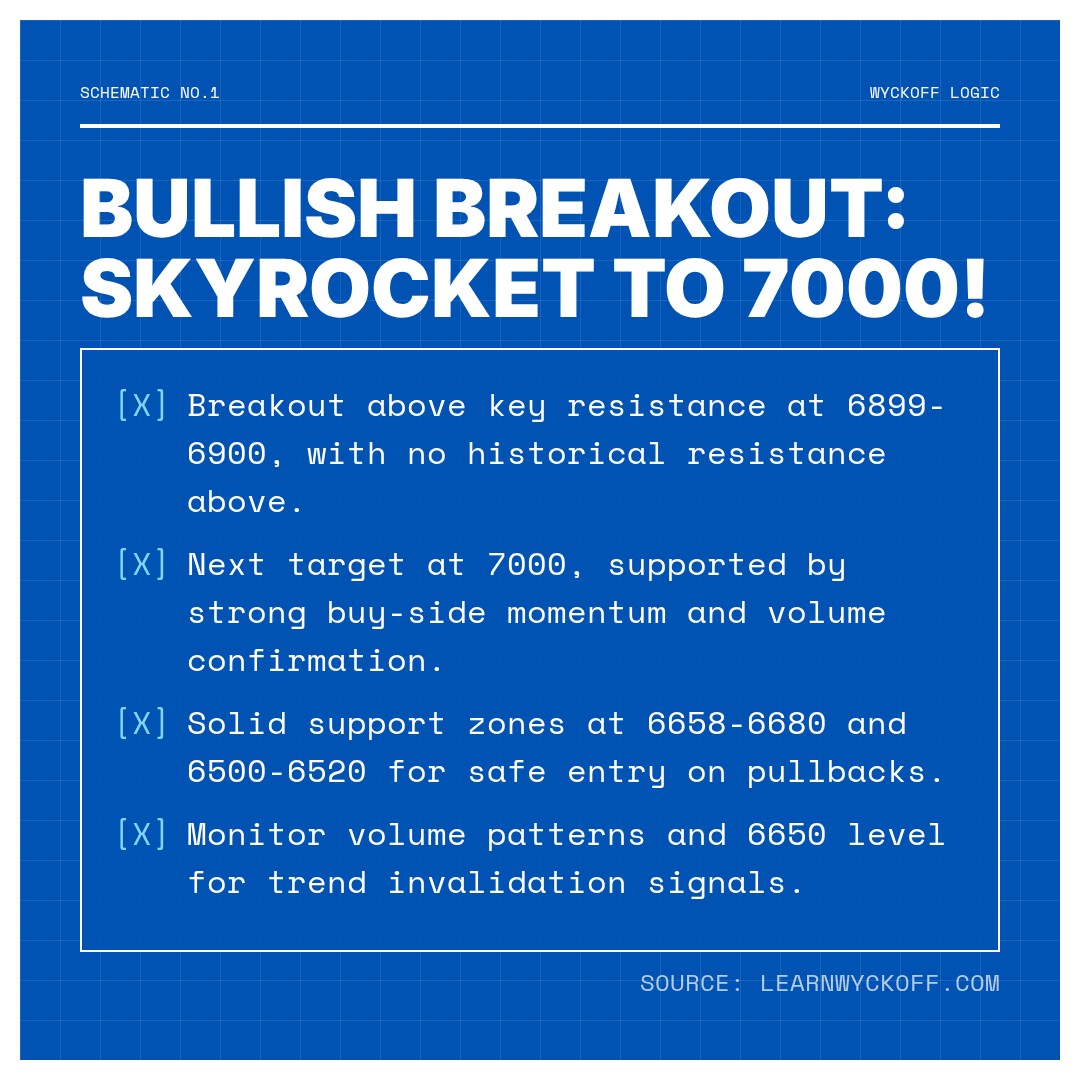
  • Major Resistance (Breached): ~6899-6900 (2026-01-08 high, ranking 10th in nearly a decade).
  • Current Resistance/Target: As the price has breached historically high-ranking levels, there is no clear historical technical resistance above. The next psychological resistance is at the 7000 integer level.
  • Key Support Levels:
    • Strong Support: ~6658-6680 (2026-01-05 closing price and the upper edge of the breakout gap area). This area also serves as the launch platform for the recent rally.
    • Core Support: ~6500-6520 (the upper edge of the December 2025 to early January 2026 consolidation platform, and near the MA_20D). This level is the critical demarcation for whether the trend weakens.

6.2 Integrated Trading Signals and Operational Suggestions:

  • Integrated Judgment: Strongly Bullish. Multiple dimensions—trend, price-volume, momentum, and fund behavior—all emit strong signals for continued upward movement.
  • Operational Suggestions:
    1. 1. Current Holders: Continue holding. Consider raising the stop-loss level to just below 6650 to protect most profits.
    2. 2. Seeking Entry: Not recommended to chase the high. Wait for a price pullback to the support zones (6680-6720 or 6500-6550), coupled with light-volume stabilization (e.g., VOLUME_AVG_7D_RATIO falling back to around or below 1.0), as a low-risk entry opportunity.
    3. 3. Potential Add-on Point: If the price experiences a single-day minor pullback on light volume (volume falls below the recent average), it could serve as an add-on point.
  • Risk Warnings and Future Validation Points:
    1. 1. Bullish Invalidation Signal: Price breaching the 6650 support on heavy volume (volume ratio > 1.2) would indicate a failed breakout and potential interruption of the uptrend, necessitating significant position reduction.
    2. 2. Trend Termination Early Warning Signal: After the price rises near 7000 or higher, the appearance of single-day or consecutive days of massive volume with price stagnation or even closing down (e.g., increased daily range, closing near lows), coupled with bearish divergence on the RSI, would be an early sign of smart money beginning distribution, serving as a crucial exit warning.
    3. 3. Ongoing Validation Point: A healthy rally should maintain the rhythm of "advances on high volume, pullbacks on low volume." Continuous monitoring is needed to see if volume during correction days is effectively controlled.

Disclaimer: This report is based on historical data and quantitative model analysis. All conclusions are probabilistic inferences and do not constitute direct investment advice. Financial markets carry risks; invest with caution.


Thank you for your attention! Daily Wyckoff price-volume market interpretations are released promptly at 8:00 AM before the market opens. Comments and shares are greatly appreciated. Your recognition is crucial. Let's work together to see the market signals.