Wyckoff Quantitative Analysis Report: Product Code 399934
Analysis Date Range: 2025-11-10 to 2026-01-09
Report Generation Date: 2026-01-09
Executive Summary
Based on Wyckoff analysis of price-volume data and historical rankings from November 10, 2025, to January 9, 2026, the underlying asset (399934) has undergone a complete cycle from "panic selling" to "strong rebound" and then to a "test at the distribution top." The current market is experiencing a significant correction within a medium-term uptrend, with supply emerging near a key resistance zone (6290-6300). Short-term volatility has surged to historically extreme levels, suggesting a dramatic shift in market sentiment. Comprehensive judgment indicates the market is in the "Distribution and Testing Phase after an advance." The subsequent direction depends on the test results of the lower key support zone (6220-6180). A strategy of "Cautious Observation, Awaiting Clear Supply/Demand Signals" is recommended.
1. Trend Analysis and Market Phase Identification
As of January 9, 2026, for underlying asset 399934:
Open Price: 6323.49, Close Price: 6298.45,
5-Day Moving Average: 6377.16, 10-Day MA: 6333.54, 20-Day MA: 6271.10,
Daily Change: -0.34%, Weekly Change: 0.47%, Monthly Change: 0.47%, Quarterly Change: 0.47%, Yearly Change: 0.47%

Price and Moving Average Relationships:
- • Bull/Bear Alignment: The current price (6298.45) has fallen below the MA_5D (6377.16) and MA_10D (6333.54), but remains above the MA_20D (6271.10), MA_30D (6237.53), and MA_60D (6250.00). The MA_30D and MA_60D are beginning to curve upward slowly, while the short-term moving averages are turning down. This constitutes a pattern of "Short-term bearish adjustment, medium-to-long-term uptrend remains intact."
- • Moving Average Crossover Signals: During the sharp rally on January 6, the MA_5D crossed above the MA_20D, issuing a short-term bullish crossover signal. However, the subsequent rapid price decline caused the MA_5D to turn downward, indicating the signal failed amidst extreme volatility. No clear trend-confirming crossover is currently formed.
Market Phase Identification (Wyckoff Cycle):
- 1. Accumulation Phase: Late November 2025. The price rebounded from the low of 6166.10 on November 21, accompanied by a significant increase in volume (e.g., VOLUME_AVG_7D_RATIO reached 1.44 on November 20), consistent with the characteristics of large capital accumulation following panic selling.
- 2. Markup Phase: Early December 2025 to January 6, 2026. The price climbed steadily, with successive higher highs and higher lows (e.g., Dec 18 high/low: 6274.72/6192.15; Jan 6 high/low: 6501.13/6359.65). Although there were pullbacks, volume was well supportive on up days (e.g., a 1.31% gain on December 5 with a VOLUME_AVG_7D_RATIO of 1.44).
- 3. Distribution and Test Phase: January 6, 2026, to present. After hitting a new high of 6501.13, the price fell for three consecutive trading days with elevated volume (Jan 7, 8, 9), representing "Upthrust/Upthrust After Distribution (UT/UTAD)", indicating supply influx near historical highs. The current price decline is testing the support of the prior uptrend.
2. Price-Volume Relationship and Supply-Demand Dynamics
As of January 9, 2026, for underlying asset 399934:
Open Price: 6323.49, Close Price: 6298.45,
Volume: 8056853800, Daily Change: -0.34%,
7-Day Average Volume: 8156026085.71, 7-Day Volume Ratio: 0.99

Key Day Analysis:
- • High-Volume Plunge (Panic Selling): November 21, 2025, the price fell sharply by -1.98%, with volume (VOLUME_AVG_7D_RATIO=1.30) significantly exceeding recent averages. This is a classic panic selling event, marking the end of a downtrend.
- • High-Volume Advance (Demand Dominated): January 6, 2026, the price surged 2.15%, with volume reaching a new high within the data period (VOLUME_AVG_7D_RATIO=1.93). This is a sign of strong demand, but occurring after a sustained advance, it warrants caution as it may represent a final "climactic buying" episode.
- • High-Volume Stalling/Decline (Supply Dominated): January 8, 2026, the price fell sharply by -1.83%, while volume remained elevated (VOLUME_AVG_7D_RATIO=1.14). This is a signal of complete supply control, confirming the possibility of a distribution phase. The following day (Jan 9) saw a small decline on lower volume (VOLUME_AVG_7D_RATIO=0.99), indicating diminished selling pressure.
Volume Anomaly Quantification:
- • The current 7-day average volume ratio (VOLUME_AVG_7D_RATIO) is 0.99, close to the average level, indicating a temporary standoff between bulls and bears.
- • Compared to the extreme volume surge on January 6 (1.93) and the high-volume decline on January 8 (1.14), the price-volume structure of "massive volume advance immediately followed by massive volume decline" clearly reveals a dramatic shift in supply-demand dynamics at high levels, with supply-side strength increasing significantly.
3. Volatility and Market Sentiment
As of January 9, 2026, for underlying asset 399934:
Open Price: 6323.49,
7-Day Intraday Volatility: 0.15, 7-Day Intraday Volatility Ratio: 1.22,
7-Day Historical Volatility: 0.26, 7-Day Historical Volatility Ratio: 1.45,
RSI: 51.40

Volatility Levels and Changes:
- • Extreme Event: Historical ranking data shows that as of January 9, the "7-day/14-day Historical Volatility Ratio" (HIS_VOLA_RATIO_7D_14D=1.45) hit a record high for the past decade (Rank #1). This indicates short-term volatility has amplified drastically in an extremely short period, far exceeding medium-term volatility levels, which typically occurs at major trend inflection points or during periods of panic/euphoria.
- • Volatility Evolution: The 7-day historical volatility (HIS_VOLA_7D) was at a historically low extreme at the end of December (0.041 on December 29, Ranked #3 lowest historically), then surged in early January, reaching 0.262 by January 9. This transformation "from extreme calm to extreme turbulence" is the quantitative manifestation of market sentiment shifting from hesitation to divergence or even panic.
- • RSI Confirmation: The RSI_14 entered the overbought zone on January 6 (73.23), then quickly retreated to a neutral-to-weak zone (51.40 on January 9). Market sentiment experienced rapid cooling.
4. Relative Strength and Momentum Performance
Periodic Return Analysis:
- • Short-term Momentum Weakening: WTD_RETURN (0.47%) and MTD_RETURN (0.47%) are positive but very low, indicating recent upward momentum has stalled. The large gain on January 6 (+2.15%) has been mostly erased by the declines over the next two days (-0.93%, -1.83%).
- • Medium-term Momentum Still Present: QTD_RETURN (0.47%) and YTD (0.47%) are synchronized, indicating that from a medium-term (quarterly, yearly) perspective, the overall uptrend has not yet been broken. However, caution is warranted as further price declines could lead to negative medium-term momentum.
Conclusion: Short-term momentum shows severe exhaustion or even reversal, but the medium-term trend has not yet been confirmed as over. Momentum analysis aligns with trend and price-volume conclusions: the market is in a short-term correction period following a prolonged advance.
5. Large Investor (Smart Money) Behavior Identification
Based on Wyckoff principles and the above data analysis, inferences regarding large investor intent are as follows:
- 1. Accumulation Behavior: During the panic selling day on November 21, 2025, and the subsequent high-volume rebound (e.g., November 20), the massive trading volume likely included active buying by large investors, who absorbed selling pressure during market panic, completing accumulation at low levels.
- 2. Distribution Behavior: During the high-volume advance on January 6, 2026, the price hit a new high but the daily candlestick had an upper shadow. Combined with the even higher-volume decline over the next two days, it can be inferred that some smart money likely took advantage of market euphoria to distribute at historical highs. The high-volume plunge on January 8 is direct evidence of substantial supply emerging after distribution.
- 3. Current Behavior: On January 9, volume returned to normal levels with a small price decline. Smart money may be observing the market's reaction to the decline, testing the strength of demand below and the confidence of holders. This is a typical "test" behavior.
6. Support/Resistance Level Analysis and Trading Signals

Key Price Levels:
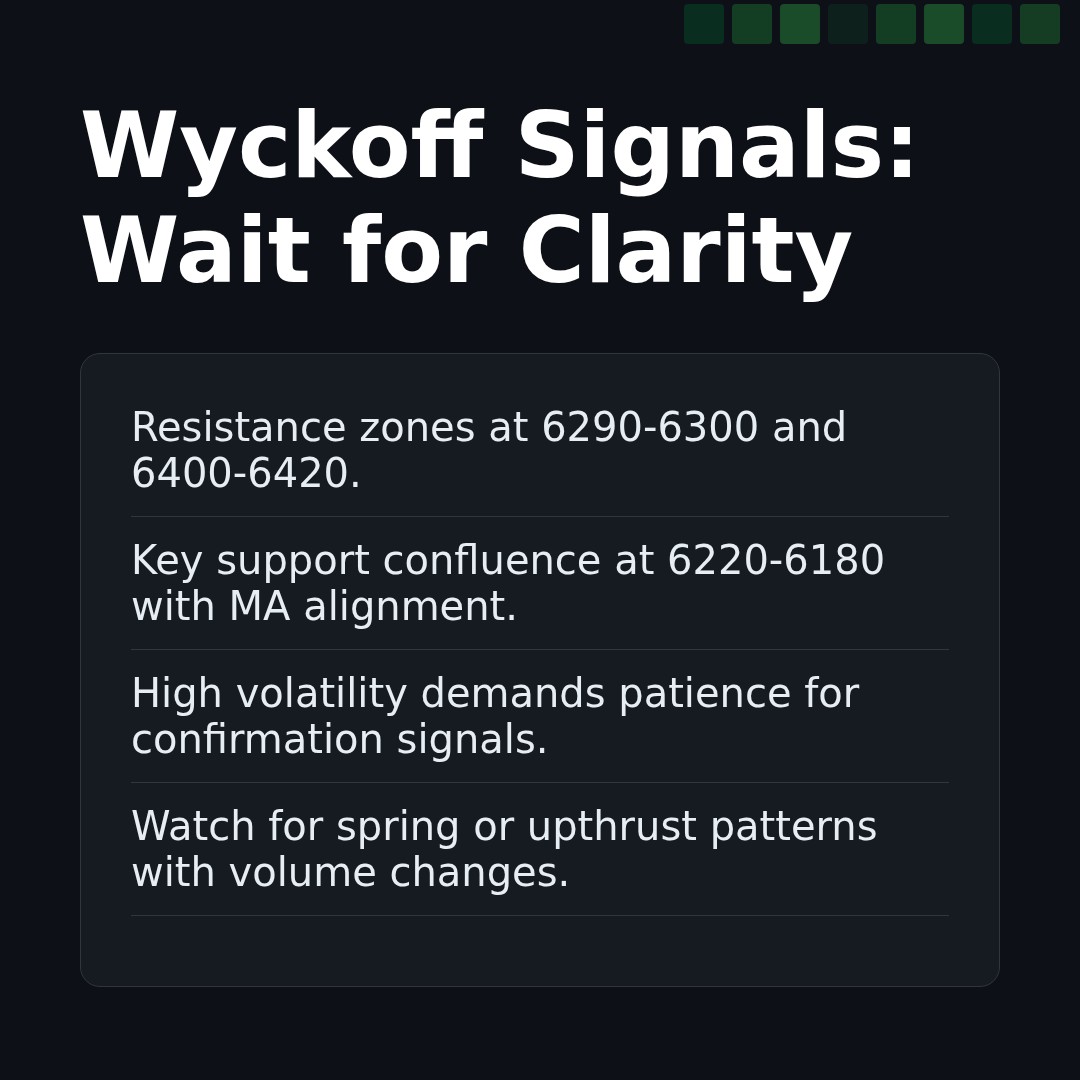
- • Immediate Resistance: 6290 - 6300 zone. This is the minor rebound resistance following the decline from the January 9 high (6344.52) and coincides with the MA_10D.
- • Core Resistance: 6400 - 6420 zone. Formed by the price congestion area of January 7-8 and the MA_5D.
- • Key Support: 6220 - 6180 zone. This is a multi-technical confluence area: (a) The region of the MA_30D (6237.53) and MA_60D (6250.00), (b) The upper boundary of the price consolidation platform from mid-to-late December.
- • Strong Support: 6100. The low area from the early December price correction.
Comprehensive Wyckoff Trading Signals and Operational Recommendations:
- • Current Market Phase: Distribution and Testing Phase within an uptrend.
- • Composite Signal: Bearish (Short-term), Observe/Wait (Medium-term). Short-term supply is evident, but the medium-term trend is not broken, so blindly chasing shorts is inadvisable.
- • Operational Recommendations:
- 1. Observe/Wait: Given volatility is at historically extreme levels and market noise is high, the primary strategy is observation, waiting for volatility to contract and clear supply-demand signals.
- 2. Confirming the Bearish Scenario: If a price rebound fails to effectively break through the 6290-6300 resistance zone (manifested as low volume or high-volume stalling), and subsequently breaks below the 6220-6180 key support zone on increased volume, it would confirm successful distribution and the continuation of the downtrend. At that point, consider initiating a light short position on a rebound to resistance, with a stop-loss set above 6400.
- 3. Confirming the Bullish Scenario: If the price finds strong support in the 6220-6180 key support zone (manifested as significantly reduced volume on decline or high-volume V-shaped recovery), it would suggest the correction within the uptrend may be over, with smart money still providing support or re-accumulating. At that point, consider entering a long position after the price stabilizes at support, with a stop-loss set below 6100.
- • Future Key Validation Points:
- • Demand Recovery Signal: A "spring" or "secondary test" pattern appears at the support level, accompanied by contracting volume.
- • Supply Confirmation Signal: A "upthrust" or "weak rally" occurs at the resistance level, accompanied by expanding volume.
- • Volatility: Monitor whether HIS_VOLA_7D begins to contract from high levels; this is a prerequisite for market sentiment stabilization and new trend development.
Disclaimer: This report is based on historical data and quantitative models for analysis. The conclusions are probabilistic inferences of market conditions and do not constitute any investment advice. Financial markets carry risks; invest with caution.
Thank you for your attention! Daily Wyckoff price-volume market insights are released promptly at 8:00 AM before the market opens. Please feel free to comment, like, and share; your recognition is crucial. Let's see the market signals together.
Member discussion: