Excellent. As a quantitative trading researcher proficient in the Wyckoff method, I will compose a comprehensive and in-depth quantitative analysis report for 399808 (analysis period: 2025-11-10 to 2026-01-09) based on the provided data table and historical ranking indicators. The report will strictly adhere to the six dimensions you requested, with all conclusions derived from the data and consistent with Wyckoff principles.
Product Code: 399808 Quantitative Analysis Report
Analysis Period: 2025-11-10 to 2026-01-09
Report Generation Time: 2026-01-09
1. Trend Analysis and Market Phase Identification
As of 2026-01-09, the underlying asset 399808 had an open price of 2932.39, a close price of 2955.14, a 5-day moving average (MA) of 2898.88, a 10-day MA of 2870.27, a 20-day MA of 2803.48, a daily gain of 0.63%, a weekly gain of 4.98%, a monthly gain of 4.98%, a quarterly gain of 4.98%, and a yearly gain of 4.98%.

- • Moving Average Alignment and Price Action:
- • Initial State (Early November): The price (~3050) was above all moving averages (MA_5D ~2994, MA_60D ~2512), displaying a typical bullish alignment, indicating the market was at the tail end of a clear uptrend.
- • Trend Reversal and Decline (Mid-November to December): Starting November 18th, the price successively broke below the MA_5D, MA_10D, and MA_20D. After the panic plunge on November 21st, the price (2719) fell below the MA_60D (2647), marking the breakdown of the long-term uptrend and the market's entry into a bear-dominated phase. Throughout December, the price traded below the MA_60D, with the MA_5D and MA_10D consistently acting as resistance.
- • Trend Repair and Rebound (Early January): Entering January 2026, the price staged a strong rebound, successively breaking above the MA_5D, MA_10D, and MA_20D. As of January 9th, the price (2955) has reclaimed position above the MA_20D (2803) and MA_30D (2790), but remains below the MA_60D (2817). The moving average alignment is gradually transitioning from bearish to convergence/consolidation, with the MA_5D (2899) showing signs of crossing above the MA_10D (2870) to form a short-term golden cross.
- • Market Phase Inference (Based on Wyckoff Theory):
- • 2025-11-10 to 2025-11-20: Distribution Phase. Prices exhibited wide fluctuations within the historical high zone (3069-3088), accompanied by extremely high trading volume (historical ranking top 20) and turnover (historical ranking top 5). However, the price failed to make new effective highs (the high of 3083 on November 13th was lower than the high of 3088 on November 10th), displaying characteristics of "high volume without significant price advancement," fitting the typical pattern of large investors distributing holdings.
- • 2025-11-21 to 2025-11-25: Panic Selling. A single-day plunge of -6.26% occurred on November 21st with increased volume. Simultaneously, turnover reached the 3rd highest record in nearly 10 years (historical ranking #3). This is a clear signal of concentrated, panic-driven release of supply (selling pressure), marking the end of the distribution phase and the acceleration of the downtrend.
- • 2025-11-26 to 2025-12-22: Automatic Rally & Secondary Test. Following the panic low (2719), the market experienced a technical rebound to around 2800, but volume sharply contracted (VOLUME_AVG_14D_RATIO dropped as low as 0.58, reaching the 8th lowest position in nearly 10 years), indicating weak demand. Subsequently, the price fell again to test support but did not make new lows, and volume continued to shrink at low levels, suggesting supply was gradually exhausting and the market was entering a potential accumulation zone.
- • 2025-12-23 to Present (2026-01-09): Preliminary Uptrend after Accumulation. Starting from December 23rd (2791), prices have risen steadily. Particularly after entering January, the rebound has been accompanied by significantly increased volume (VOLUME_AVG_7D_RATIO recovering above 1.20), indicating new demand entering at lower price levels. The market may be transitioning from the accumulation phase to the initial stages of a new uptrend.
2. Volume-Price Relationship and Supply-Demand Dynamics
As of 2026-01-09, the underlying asset 399808 had an open price of 2932.39, a close price of 2955.14, a trading volume of 5284654000, a daily gain of 0.63%, a trading volume of 5284654000, a 7-day average volume of 4389072908.86, and a 7-day volume ratio of 1.20.

- • Key Demand Days:
- • 2025-11-13: The price rose 4.73% with a volume of 66.8 billion (historical ranking #14), a classic "high-volume advance" demand day. However, given its context at historical highs, this was more likely a "last gasp of demand," luring buyers in before the subsequent reversal.
- • 2026-01-05 to 2026-01-09: Multiple consecutive days of gains accompanied by steadily increasing volume (VOLUME_AVG_7D_RATIO consistently > 1.10), especially at relatively low levels following the prior decline, constitute a positive signal of renewed demand entering the market.
- • Key Supply Days and Turning Points:
- • 2025-11-10: The price fell -0.85%, but volume reached 66.2 billion (historical ranking #16) and turnover was 202.2 billion (historical ranking #5). This is a classic "high-volume decline," indicating supply began overwhelming demand at historical highs.
- • 2025-11-21: Decisive Supply Day. The price plummeted -6.26% on a volume of 50.3 billion, with turnover reaching 136.9 billion. The extremely high turnover (historical ranking #3) indicates that amidst the panic, substantial capital was absorbing the sell-off. This represents the "Selling Climax (SC)" in Wyckoff theory, often marking the exhaustion of downward momentum.
- • Volume Anomaly Analysis:
- • Supply Exhaustion Signal: From late November to mid-December 2025, VOLUME_AVG_14D/21D/30D_RATIO repeatedly touched extreme lows for nearly a decade (ranking #1, #4, #6, etc.), especially during price declines or narrow consolidations. This indicates a significant reduction in selling意愿 (willingness to sell) and supply drying up, creating conditions for a subsequent rebound.
- • Demand Recovery Signal: In early January 2026, volume ratios (VOLUME_AVG_7D/14D_RATIO) quickly recovered to the 1.2-1.4 range, showing a marked increase in demand activity and strengthening buying power.
3. Volatility and Market Sentiment
As of 2026-01-09, the underlying asset 399808 had an open price of 2932.39, a 7-day intraday volatility of 0.21, a 7-day intraday volatility volume ratio of 0.99, a 7-day historical volatility of 0.21, a 7-day historical volatility volume ratio of 0.94, and an RSI of 63.43.

- • Volatility Peaks and Panic Sentiment:
- • On the panic selling day of 2025-11-21, HIS_VOLA_7D surged to 66.6% and PARKINSON_VOL_7D was 39.2%. HIS_VOLA_RATIO_7D_60D reached 1.39, indicating short-term volatility far exceeded long-term levels, and market sentiment reached a panic extreme. RSI_14 dropped rapidly from 67 on November 10th (near overbought) to 42 on November 21st (near oversold), confirming the extreme reversal in sentiment.
- • Volatility Contraction and Sentiment Repair:
- • Entering December, various volatility indicators (HIS_VOLA, PARKINSON_VOL) and their ratios retreated rapidly. By late December, PARKINSON_VOL_7D once dropped as low as 21.0%, showing significant volatility contraction as market sentiment shifted from panic to calmness and hesitation.
- • During the early January 2026 rally, volatility (HIS_VOLA_7D ~28.9%) and volatility ratios (HIS_VOLA_RATIO_7D_60D ~0.69) recovered but remained at moderate levels. RSI_14 recovered to 63, indicating market sentiment has turned optimistic but is not yet at an extreme overbought level, which is favorable for the healthy development of the trend.
4. Relative Strength and Momentum Performance
- • Momentum Collapse and Repair:
- • November 2025: Momentum turned sharply negative. From November 10th to November 24th, prices experienced a significant pullback, with MTD_RETURN shifting from +5.8% to -6.7%, completely destroying short-term momentum.
- • December 2025: Momentum hovered at low levels. Despite a rebound towards month-end, MTD_RETURN ultimately closed at +1.0%, indicating the market was in a repair and bottoming process, lacking strong upward momentum.
- • January 2026 (as of Jan 9): MTD_RETURN strongly turned positive to +5.0%, and WTD_RETURN reached +5.0%. Short-term momentum has significantly strengthened, corroborating signals from price breaking above moving averages and expanding volume, suggesting the market now possesses upward attack动能 (momentum).
5. Large Investor (Smart Money) Behavior Identification
Based on the above volume-price, volatility, and phase analysis, the operational path of large investors can be inferred:
- 1. Distribution at Highs (Early-Mid November 2025): At historical high levels (3060-3080), leveraging market optimism and active trading (record-breaking turnover), large-scale distribution of holdings was completed via the "high volume without significant price advancement" pattern. VOLUME_AVG_7D_RATIO reaching historical top 20 highs quantifies the activity level during this phase.
- 2. Inducing Panic and Absorbing Sell-off (Around November 21, 2025): Triggering a price collapse through active or passive selling, forming a Selling Climax (SC). The massive turnover ranking #3 historically indicates that while retail investors panicked and sold, organized large-scale capital absorbed enormous selling pressure at low levels. This is a classic "panic selling - accumulation" combination.
- 3. Testing and Consolidating Accumulation (Late November to December 2025): Following the panic low, allowing the market to experience a low-volume rally (Automatic Rally - AR) and a Secondary Test (ST). Volume ratios hitting multi-year extremes indicate extremely low public participation, thorough cleansing of floating supply, and smart money silently consolidating low-level positions.
- 4. Initiating a New Market Cycle (Late December 2025 to Early January 2026): After sufficient accumulation and testing, beginning to push prices higher using the "high-volume advance" pattern to attract trend followers, initiating the breakout process upward from the accumulation range. The consecutive high-volume days in early January signal smart money starting to operate actively.
6. Support/Resistance Level Analysis and Trading Signals

- • Key Support Levels:
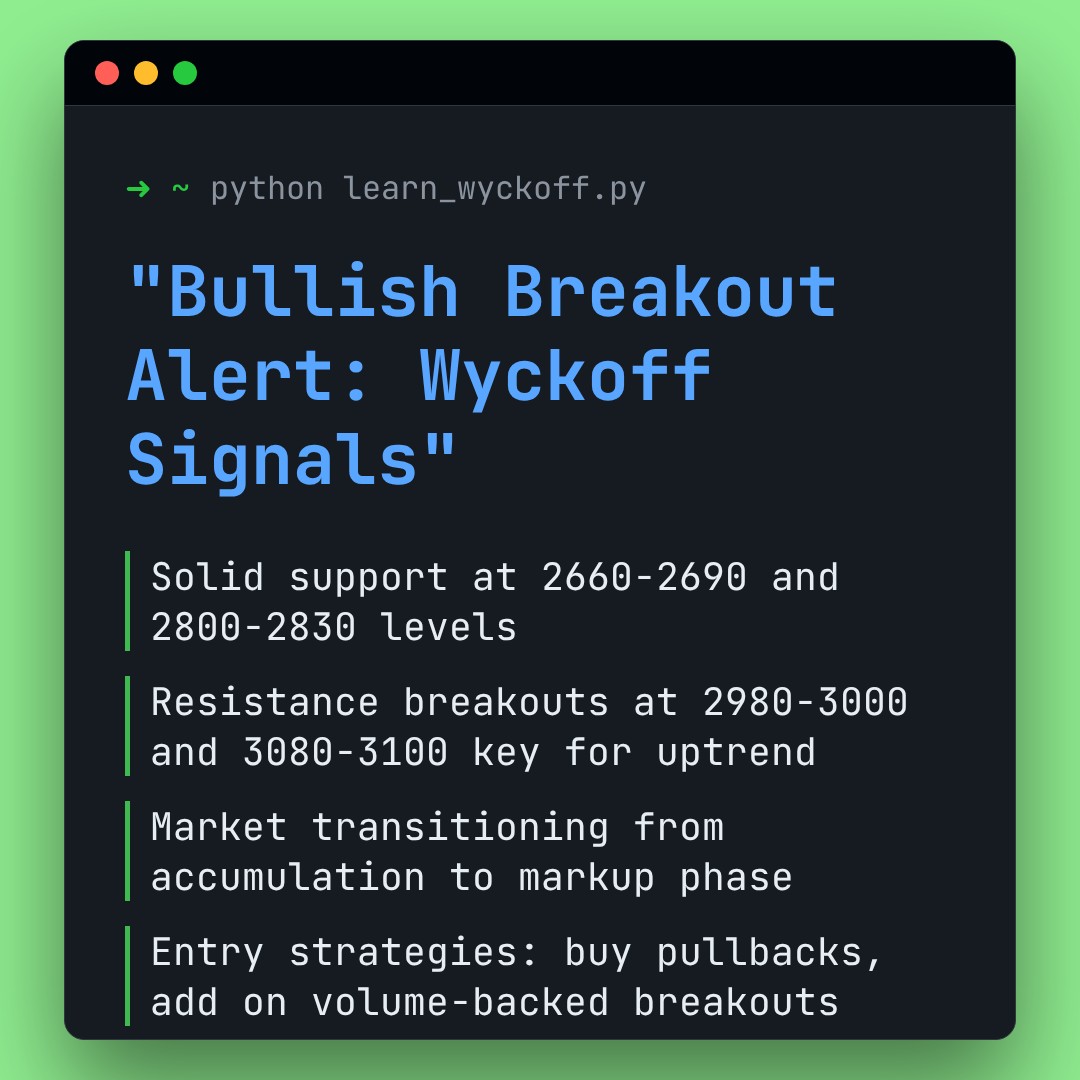
- • Primary Support: 2660-2690 range. Corresponds to the panic low area on 2025-11-24/25, also the ultimate low of this correction, which has been tested on low volume, making it solid support.
- • Secondary Support: 2800-2830 range. Corresponds to the MA_30D and the upper boundary of the December consolidation range, now serving as a pullback support level.
- • Key Resistance Levels:
- • Primary Resistance: 2980-3000 range. Corresponds to the lower boundary of the November 2025 distribution range and the intraday high on 2026-01-09. A breakout above this area would confirm a strengthening uptrend.
- • Core Resistance: 3080-3100 range. The historical high zone from November 2025, the main target for bulls to overcome in the future.
- • Comprehensive Wyckoff Trading Signals and Actionable Recommendations:
- • Current Signal: Cautiously Bullish. The market has emerged from the panic and accumulation phases, displaying a positive combination of "high-volume advance + moving average repair + strengthening momentum." Large investor behavior has shifted from distribution/accumulation to markup.
- • Actionable Recommendations:
- 1. Entry Consideration: Consider establishing long positions in tranches when the price pulls back to the 2800-2830 support area and shows low-volume stabilization signals. Aggressive traders may consider entering upon a volume-backed (VOLUME_AVG_7D_RATIO > 1.1) breakout above 2980.
- 2. Stop-Loss Placement: Stops for long positions should be placed below the 2660 support level to manage the risk of an extreme market retracement.
- 3. Target Outlook: The initial target is testing the 3080-3100 historical resistance zone. A successful breakout would open new upside potential.
- • Future Validation Points (Require Close Monitoring):
- 1. Positive Validation: When the price approaches or tests the 2980-3000 resistance, observe whether volume can sustain moderate expansion (not anomalously high) without the appearance of long-upper-shadow, stalling candlesticks. If so, the advance is healthy.
- 2. Risk Warning: If the price exhibits "single or consecutive days of high volume but price stalling or even declining" in the 2980-3000 area (single-day volume > 60 billion, VOLUME_AVG_7D_RATIO > 1.3, but gain < 1% or close lower), a new distribution structure may be forming. Timely profit-taking and exiting is advised, along with reassessing the market phase.
- 3. Trend Failure Signal: If the price breaks below 2800 on high volume and fails to recover quickly, it would indicate this rebound might have failed, and the market could revert to a low-level consolidation pattern.
Conclusion Reiteration: Analysis of 399808 based on Wyckoff volume-price principles indicates that this underlying asset experienced a complete high-level distribution and panic-driven decline in November 2025, followed by a low-level accumulation process from late November to December 2025. Currently (as of 2026-01-09), the market shows signs of demand regaining dominance. Combined with the inferred trajectory of large investor behavior, the market is in the initial stages of transitioning from the accumulation phase to a new uptrend. A strategy leaning towards "buying on pullbacks, adding on breakouts" is recommended, while strictly implementing stop-losses and closely monitoring volume-price behavior at key resistance levels.
Disclaimer: This report/analysis content is solely market analysis and research based on publicly available information and does not constitute any investment advice or operational guidance. The author strives for objectivity and fairness but makes no guarantees regarding accuracy or completeness. The market involves risks; investment requires caution. Any investment actions taken based on this report are at your own risk.
Thank you for your attention! Wyckoff volume-price market解读 (interpretations) are published daily at 8:00 AM before the market opens. Your comments and shares are greatly appreciated. Your recognition is crucial. Let's work together to clearly see the market signals.
Member discussion: