Quantitative Analysis Report: HSI (Hang Seng Index)

Product Code: HSI
Analysis Period: 2025-11-10 to 2026-01-08
Report Generation Date: 2026-01-08


I. Trend Analysis and Market Phase Identification

As of 2026-01-08, the underlying asset HSI had an opening price of 26302.78, a closing price of 26149.31, a 5-day moving average (MA) of 26297.13, a 10-day MA of 26037.03, a 20-day MA of 25806.99. The daily change was -1.17%, weekly change 2.02%, monthly change 2.02%, quarterly change 2.02%, and yearly change 2.02%.

HSI Price Trend Analysis Chart, including closing price and multiple moving averages

Current MA Alignment and Trend Assessment:

  • Bullish Alignment Confirmed: As of the latest trading day (2026-01-08), the moving averages are aligned as MA_5D (26297.13) > MA_20D (25806.986) > MA_30D (25846.456). The price (26149.31) is above all major moving averages. This indicates an upward short-to-medium-term trend with a bullish structure.
  • Key Crossover Signal: The MA_5D decisively crossed above and held above the MA_20D (25749.565) on 2026-01-06 (close: 26710.45), forming a "Golden Cross." This signal reinforces the recovery of short-term upward momentum.
  • Price Action Analysis: Reviewing the analysis period, the market has gone through three distinct phases:
    1. 1. Mid-to-late November Decline: A clear downward wave from the high of 27016.40 on November 12th to the low of 25178.63 on November 21st.
    2. 2. December Consolidation/Bottoming: Price oscillated repeatedly within the 25200-26000 range. The low (25086.54 on Dec 16th) did not breach the previous low, exhibiting characteristics of a support test.
    3. 3. Strong Rebound in Early January: Starting from the first trading day of 2026 (01-02), HSI broke through the 26000 psychological level on high volume, reaching a new high of 26858.13 for the period on 01-06. Despite a pullback over the following two days, it remains above key moving averages and the 26000 level.

Wyckoff Market Phase Inference:
Based on price action and volume-price relationships (detailed in Part II), it can be inferred that the market has completed a transition over the past two months from "decline/panic" to "accumulation," and is now in a transition phase towards "uptrend/re-accumulation/initial distribution." The range-bound consolidation in December, accompanied by exceptionally high volume (see historical ranking data), aligns with the characteristics of a "Trading Range" in Wyckoff theory. The rally in early January represents a "demand-dominated markup" breaking out of that range. The current high-volume pullback at elevated prices warrants caution for a potential early transition into a "distribution" phase.


II. Volume-Price Relationship and Supply-Demand Dynamics

As of 2026-01-08, the underlying asset HSI had an opening price of 26302.78, a closing price of 26149.31, volume of 268274751780, a daily change of -1.17%, volume of 268274751780, a 7-day average volume of 219351631666.86, and a 7-day volume ratio of 1.22.

HSI Volume-Price Relationship Line Chart and Historical Ranking Analysis

Core Volume-Price Analysis:

  1. 1. Panic Selling and Massive Absorption (Accumulation Signal):
    • 2025-12-29: Price declined -0.71%, but volume surged by 142.65%, marking the 2nd highest single-day volume increase in nearly 10 years (HISTORY_RANK: 2). This is a classic signature day for "panic selling" and "absorption by large investors (smart money)". According to Wyckoff principles, a high-volume decline at a low point after a prolonged downtrend, without a new closing low, often signals the final stages of accumulation.
    • 2026-01-05: Price increased marginally by 0.03%, with volume surging again by 101.23% (HISTORY_RANK: 16). Such massive volume at elevated prices, combined with price stagnation, provides an initial warning that supply is emerging.
  2. 2. Demand-Dominated Rally:
    • 2026-01-06: Price rose 1.38%, supported by sustained high volume (VOLUME_AVG_60D_RATIO = 1.2547), indicating the rally was accompanied by effective volume expansion, signifying strong demand.
  3. 3. Emerging Supply and Distribution Concerns:
    • 2026-01-07 & 01-08: Price declined for two consecutive days (-0.94%, -1.17%), with volume reaching 1.178 and 1.153 times the 60-day average, respectively. This is a typical "high-volume decline," indicating that supply is beginning to overwhelm demand. This is particularly concerning when it occurs after a new high, increasing the probability of a transition from an "uptrend" to "distribution."

Interpretation of Abnormal Volume Indicators:

  • VOLUME_AVG_60D_RATIO: This indicator remained above 1 from December 29th through January 8th, peaking (>1.23) on January 5th-6th. This shows recent trading activity far exceeds the average of the past two months, indicating the market is at a critical juncture.
  • Conclusion: Supply and demand forces have shifted dramatically recently. The massive volume in late December marked bottom absorption. The high-volume rally in early January signaled demand release. The subsequent high-volume decline is a clear signal of supply influx.

III. Volatility and Market Sentiment

As of 2026-01-08, the underlying asset HSI had an opening price of 26302.78, a 7-day Parkinson volatility of 0.15, a 7-day Parkinson volatility ratio of 1.15, a 7-day historical volatility of 0.28, a 7-day historical volatility ratio of 1.38, and an RSI of 52.92.

HSI Parkinson Volatility Analysis Chart and Historical Ranking Data

Volatility Level and Changes:

  • Volatility Expansion: The latest trading day's (2026-01-08) 7-day historical volatility (HIS_VOLA_7D) is 27.58%, significantly higher than the 60-day average volatility (22.65%), with a ratio (HIS_VOLA_RATIO_7D_60D) as high as 1.218. Meanwhile, the 7-day Parkinson volatility (PARKINSON_VOL_7D) is 0.1504, also above its 60-day average (0.1495).
  • Volatility Structure: Both HIS_VOLA_RATIO_7D_14D (1.375) and PARKINSON_RATIO_7D_14D (1.150) are greater than 1, indicating that short-term volatility is significantly higher than medium-term volatility. This structure typically appears during trend acceleration or early reversal stages, reflecting intense market sentiment swings.

Sentiment Indicator (RSI) Validation:

  • • The RSI_14 rebounded from a low of 36.39 on November 21st (approaching oversold) to a high of 63.41 on January 6th, showing a rapid shift in market sentiment from pessimism to optimism.
  • • The current RSI has retreated to 52.92, residing in a neutral-to-strong zone, showing no extreme overbought conditions, leaving room for potential future moves. The rapid improvement in sentiment aligns with the price rebound and volatility expansion.

Conclusion: Market sentiment has undergone a swift transition from a freezing point (panic) to exuberance within a short period, currently at an active but not extreme level. The elevated short-term volatility indicates significant divergence between bulls and bears, placing the market at a sensitive juncture.


IV. Relative Strength and Momentum Performance

Multi-Period Momentum Analysis:

  • Strong Short-Term Momentum: Both WTD_RETURN (2.02%) and MTD_RETURN (2.02%) are positive, confirming the robust rally momentum at the start of the new year. The rebound in early January has rapidly turned short-term momentum positive.
  • Repairing Medium-Term Momentum: A gap remains between QTD_RETURN (-3.53%) and YTD (2.02%). However, considering the analysis period started (November 10th) from a relatively high level, the negative QTD mainly reflects the decline in November-December. The January rally is rapidly repairing this loss.
  • Momentum-Trend Convergence: The strengthening of short-term momentum (WTD/MTD) validates the bullish MA alignment (trend), indicating momentum supports the current uptrend.

Conclusion: HSI's short-term momentum has significantly strengthened, resonating with the price breakout and bullish trend reversal. Medium-term momentum is still in the repair process but is directionally positive.


V. Large Investor ("Smart Money") Behavior Identification

Based on Wyckoff principles and the volume-price analysis above, inferences regarding large investor behavior are as follows:

  1. 1. Accumulation: Late December 2025 was the critical period. Specifically, on December 29th, the market experienced its 2nd highest volume surge in nearly 10 years during a decline. Combined with prices being in the relatively low 25000-26000 range, this strongly suggests "smart money" conducting large-scale, organized accumulation by capitalizing on market panic, absorbing shares sold by retail investors.
  2. 2. Testing and Markup: Subsequently, in early January 2026, the market broke above the resistance of the consolidation range (26000 level) with consecutive high-volume bullish candles (especially on Jan 2nd and 6th). This marks the successful completion of a "demand test" post-accumulation and the initiation of a rapid markup phase led by "smart money," aiming to move away from the cost zone and attract follow-through buying.
  3. 3. Initial Distribution or Shakeout: The high-volume declines on January 7th and 8th are significant warning signs. Following the rapid markup, "smart money" may have begun initial distribution at elevated levels (around 26800), transferring some holdings to chasing retail buyers. Alternatively, this could be a "shakeout" designed to wash out weak-handed followers, reducing selling pressure for a potential subsequent higher rally. The key lies in whether the price can find support at critical levels (e.g., 26000) and show signs of demand recovery.

Core Inference: Large investors successfully completed a round of low-level accumulation in late December and swiftly marked up the price in early January. The current market is at a critical decision point following this markup: to continue expanding upward or to initiate a phase of distribution. The combination of high-volume stagnation (Jan 5th) and high-volume decline (Jan 7th-8th) tilts the probability slightly towards distribution over a shakeout.


VI. Support/Resistance Level Analysis and Trading Signals

HSI Support and Resistance Level Analysis Chart and Trading Signals

Key Price Level Identification:

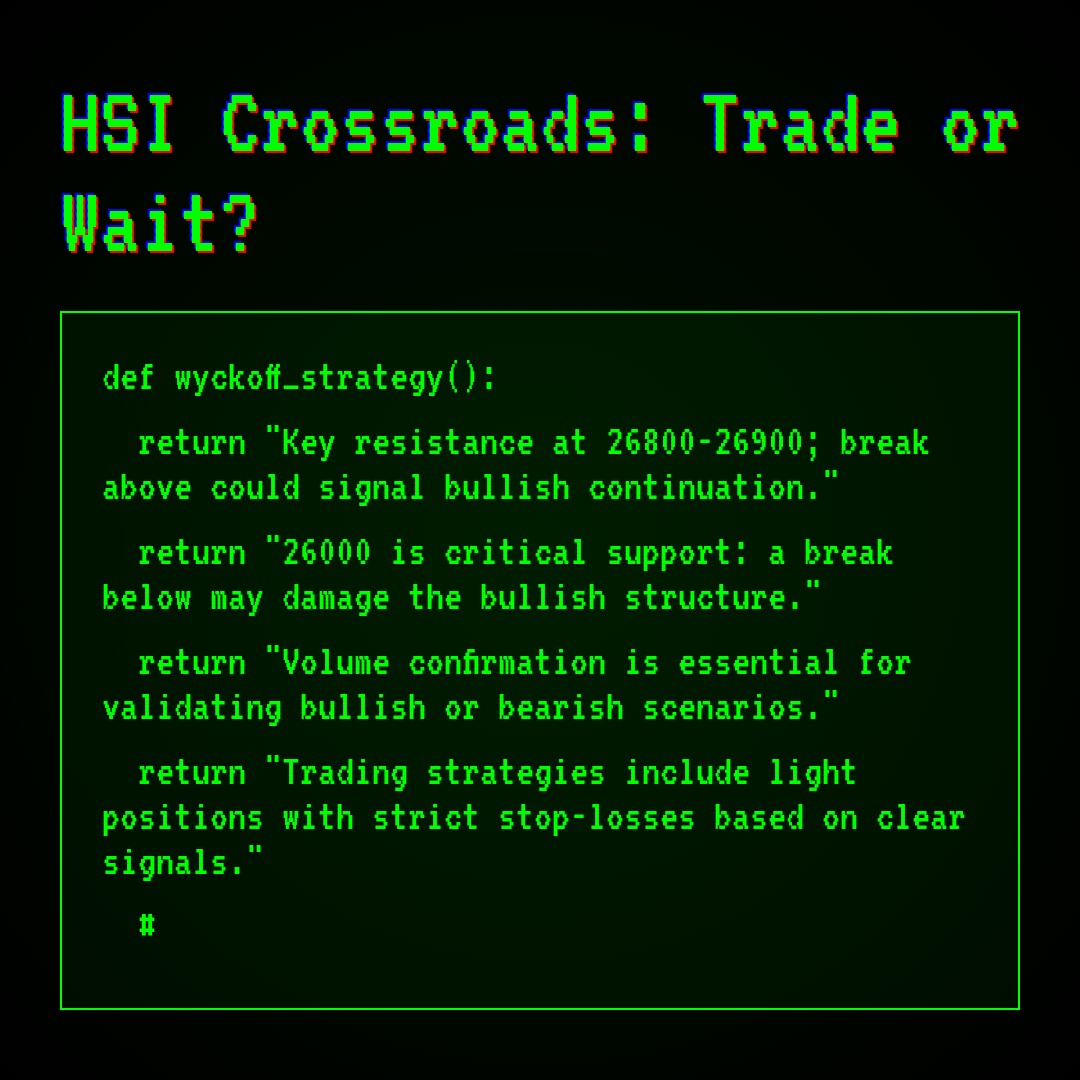
  • Strong Resistance: 26800 - 26900 zone. This area encompasses the recent rebound high (26858.13) and the vicinity of the mid-November high (27016.40), a supply-concentrated zone.
  • Critical Support/Bull-Bear Divide: The 26000 psychological level. This is the upper boundary of the previous consolidation range, a psychological barrier, and the region of the MA_20D. A decisive break below would damage the bullish structure.
  • Strong Support: 25500 - 25600 zone. This is the lower boundary of the December consolidation range, a volume concentration area, and a zone where lows were tested multiple times previously.

Comprehensive Trading Signal and Operational Suggestions:

  • Overall Signal: Wait and see, await directional confirmation. The market is in a high-level, sensitive zone with conflicting bull and bear signals (bullish trend but bearish distribution volume-price signals).
  • Bullish Scenario and Action:
    • Scenario: Price stabilizes above 26000 (especially above MA_20D), followed by a low-volume pullback or high-volume bullish candle(s), indicating supply exhaustion or demand return.
    • Suggestion: Consider light long positions in the 26000-26200 range.
    • Stop Loss: Clear break below 25900 (below the intraday low).
    • Target: Attack the 26800-27000 zone again.
  • Bearish Scenario and Action:
    • Scenario: Price rebound lacks strength, consistently faces resistance around 26500-26600 accompanied by shrinking volume (rally without demand), followed by a high-volume break below 26000.
    • Suggestion: Consider light short positions upon confirmed break below 26000 during a pullback.
    • Stop Loss: Price regains footing above 26200.
    • Target: Test the 25500-25600 support zone.
  • Future Validation Points:
    1. 1. Demand Validation: In the next 1-3 trading days, observe if price shows clear signs of stabilization (e.g., long lower shadow, low-volume small candles) or a direct high-volume bullish engulfing pattern around 26000.
    2. 2. Supply Validation: If price rebounds to around 26500, observe if volume shrinks again (rally without demand) or expands with stagnation (supply re-emerges).
    3. 3. Historical Ranking Validation: Monitor if volume indicators re-enter extreme historical rankings, which may signal the start or acceleration of a new trend.

Summary: HSI has completed a classic "accumulation-markup" move driven by "smart money." Currently, it is in a post-markup high-level contest phase. The high-volume decline signaling supply is the primary risk. Traders should remain cautious, prioritize observing price action around the 26000 critical level, execute right-sided operations based on clear volume-price signals, and strictly manage risk.


Disclaimer: The content of this report/analysis is solely for market analysis and research based on publicly available information and does not constitute any investment advice or operational guidance. The author strives for objectivity and impartiality but makes no guarantees regarding its accuracy or completeness. The market carries risks, and investing requires caution. Any investment actions based on this report are undertaken at one's own risk.


Thank you for your attention! Wyckoff volume-price market interpretations are published daily at 8:00 AM before the market opens. Your comments and shares are greatly appreciated. Your recognition is crucial. Let us see the market signals together.