Excellent. As a quantitative trading researcher proficient in the Wyckoff Method, I will compile a comprehensive and in-depth quantitative analysis report based on the data provided for the product 513190.


Product Code: 513190 Quantitative Analysis Report

Analysis Period: 2025-11-10 to 2026-01-08
Report Generation Date: 2026-01-08


1. Trend Analysis and Market Phase Identification

As of January 08, 2026, the underlying asset 513190 has an open price of 1.81, a close price of 1.79, a 5-day moving average (MA) of 1.80, a 10-day MA of 1.78, a 20-day MA of 1.77, a daily change of -1.33%, a weekly change of 1.36%, a monthly change of 1.36%, a quarterly change of 1.36%, and a yearly change of 1.36%.

513190 Price Trend Analysis Chart, including closing price and multiple moving averages
  • Moving Average Arrangement and Price Relationship:
    • • At the end of the analysis period (2026-01-08), the price (1.787) has fallen below all short-term moving averages (MA_5D: 1.796, MA_10D: 1.784, MA_20D: 1.769), yet remains slightly above the 60-day MA (MA_60D: 1.773). This indicates the short-term trend has shifted to a bearish arrangement, but the price has not decisively broken below the key long-term trend support (MA_60D).
    • • Looking at the entire period, after reaching a high (1.874) in mid-November 2025, the price experienced a volatile decline, found support near 1.728 in mid-December, and subsequently rebounded. This rebound (2026-01-05 to 01-06) temporarily caused the MA_5D to cross above the MA_20D, forming a short-term golden cross, but the price failed to sustain its high level, leading to a rapid weakening of the golden cross signal. This constitutes a classic Wyckoff event of a "Failed Rally Test."
  • Market Phase Inference:
    • • Combined with price action: The decline from the November high (1.874) was accompanied by significantly increased volume (e.g., November 21st volume of 3.99B, the second-highest in the period), consistent with characteristics of the "Distribution" phase.
    • • The decline halted and rebounded near 1.728 in December. Initial rebound volume was moderate (Dec 5th, 8th), followed by massive volume during the early January rebound (Jan 6th volume of 3.90B), yet the price failed to make a new high (peak 1.830 vs. previous high 1.874). This aligns more with the "Secondary Test within a Distribution Range" or "Re-distribution" phase in Wyckoff theory, where large investors use rallies for final distribution of holdings.
    • Conclusion: The market is highly likely in the late stage of a "Distribution" phase or the early stage of a "Markdown" trend. The price's failure to decisively break above the previous high, coupled with "high volume price stagnation" and "high volume decline" at elevated levels, indicates supply is beginning to overwhelm demand.

2. Volume-Price Relationship and Supply-Demand Dynamics

As of January 08, 2026, the underlying asset 513190 has an open price of 1.81, a close price of 1.79, a volume of 268,157,800, a daily change of -1.33%, a volume of 268,157,800, a 7-day average volume of 295,272,029.43, and a 7-day volume ratio of 0.91.

513190 Volume-Price Relationship Line Chart and Historical Ranking Analysis
  • Key Day Analysis (Wyckoff Perspective):
    • 2026-01-06 (High-Volume Rise with Weak Close): Volume was 3.90B (third-highest in the period), price rose significantly by 1.73%, but the candlestick had an upper shadow, and the closing price (1.827) was significantly lower than the intraday high (1.830). This is a typical "Sign of Supply" signal—demand effort pushed the price higher but encountered stronger supply pressure, causing the price to retreat from the high.
    • 2026-01-08 (High-Volume Decline): Volume was 2.68B, price fell 1.33%. A high-volume decline occurring at a rebound high is a clear "Supply Dominant" day, confirming the previous day's supply signal and indicating strong bearish force.
    • 2025-11-21 (Panic High-Volume Plunge): Volume was 3.99B (second-highest in the period), price fell sharply by 1.93%. This is a "Panic Selling" event during the decline from highs, typically indicating a surge in retail selling.
    • 2025-12-05 (High-Volume Breakout Rebound): Volume was 3.09B, price surged 2.17%. This was the first significant high-volume rise after the decline, interpretable as "Preliminary Support" attracting some buying interest and laying the groundwork for the subsequent rebound.
  • Volume Anomaly Analysis:
    • • *VOLUME_AVG_D_RATIO: Recent (Jan 5th-8th) volume ratios relative to various period averages (0.79-1.53) show active trading but no extreme overbought values. However, historical ranking data reveals more critical information: The 14-day, 21-day, 30-day, and 60-day average volumes for the current period (late December to early January) have reached or approached the highest levels in nearly a decade (historical ranks 1, 2, 1, 1). From a long-term perspective, this confirms the presence of "Abnormally High Volume Turnover" in the current zone, a key characteristic of large capital activity.
    • Supply-Demand Shift: The transition from "rising price with rising volume" (demand entering) during the initial rebound in December to "falling price with rising volume" or "stagnant price with rising volume" (supply overwhelming demand) on January 6th-8th clearly demonstrates the shift in supply-demand forces within the 1.83-1.79 price range. Demand exhausted at the rebound high, and supply entered on a large scale.

3. Volatility and Market Sentiment

As of January 08, 2026, the underlying asset 513190 has an open price of 1.81, a 7-day intraday volatility of 0.18, a 7-day intraday volatility ratio of 1.25, a 7-day historical volatility of 0.25, a 7-day historical volatility ratio of 1.43, and an RSI of 52.30.

513190 Parkinson Volatility Analysis Chart and Historical Ranking Data
  • Volatility Levels and Changes:
    • • Historical Volatility (HIS_VOLA) and Parkinson Volatility have increased significantly recently. Taking January 8th as an example, HIS_VOLA_7D (0.249) is much higher than HIS_VOLA_14D (0.175) and HIS_VOLA_60D (0.219). The key HIS_VOLA_RATIO_7D_14D is as high as 1.426, ranking 6th highest in the past decade, indicating an extreme short-term volatility spike.
    • • The Parkinson Volatility ratio (PARKINSON_RATIO_7D_14D: 1.250) also shows intense short-term intraday volatility. A sudden spike in volatility often accompanies trend acceleration or reversal. Synchronized with the current price decline, this suggests the market may be entering a "panic" or "accelerated decline" sentiment phase.
  • Overbought/Oversold Status (RSI):
    • • RSI_14 reached 63.91 at the rebound high on January 6th, approaching the overbought zone. Following two days of price decline, the RSI quickly fell back to 52.30. The RSI turning downward before entering the strong overbought zone (>70) indicates insufficient upward momentum and a rapid shift in market sentiment from brief optimism to caution, validating the fragility of the rebound.

4. Relative Strength and Momentum Performance

  • Periodic Return Analysis:
    • Short-Term Momentum (WTD_RETURN): The weekly return as of January 8th was only +1.36%, primarily contributed by the rebound on January 5th-6th, with most gains surrendered in the following two days, showing rapid momentum decay.
    • Medium-to-Long-Term Performance (TTM): Despite short-term weakness, the TTM_12 (35.38%) and TTM_24 (94.24%) returns remain very strong, suggesting the underlying asset's long-term fundamentals or beta characteristics may still be favored. The current correction may be an intermediate-level consolidation or distribution within a long-term strong uptrend.
  • Momentum and Volume-Price Trend Validation:
    • • The "brief emergence and rapid decay" of short-term momentum fully aligns with the conclusion from volume-price analysis: "Demand was unable to break past the previous high, and supply emerged." The unsustainable momentum confirms that the rise was not the beginning of a new trend.

5. Large Investor (Smart Money) Behavior Identification

  • Operational Intent Inference:
    • Distribution: This is the core judgment. At the November highs (1.87+) and the early January rebound highs (1.83), historically significant high-volume trading occurred (combined with historical ranking data). The price's inability to make new highs or even its decline on high volume is the classic behavior of smart money "Distribution"—transferring holdings to retail investors chasing the rally by leveraging market optimism and active trading.
    • Shakeout? The low-volume decline in mid-December (e.g., Dec 24th-26th) can be interpreted as a "Shakeout" within the distribution process, flushing out weak holders to create conditions for subsequent rally distribution.
    • Who is Buying? Who is Selling? In the high-volume trading zone, price stagnation indicates intense exchange between buyers and sellers. Based on Wyckoff principles, in the late stages of an uptrend, smart money (large institutions) are the primary suppliers (sellers), while the public (retail) are the primary demanders (buyers).
  • Conclusion: The behavioral patterns of large investors over the past two months (especially recently) clearly point towards "Distribution at High Levels." They have utilized every rally to attract buyers while selling.

6. Support/Resistance Level Analysis and Trading Signals

513190 Support/Resistance Level Analysis Chart and Trading Signals
  • Key Levels:
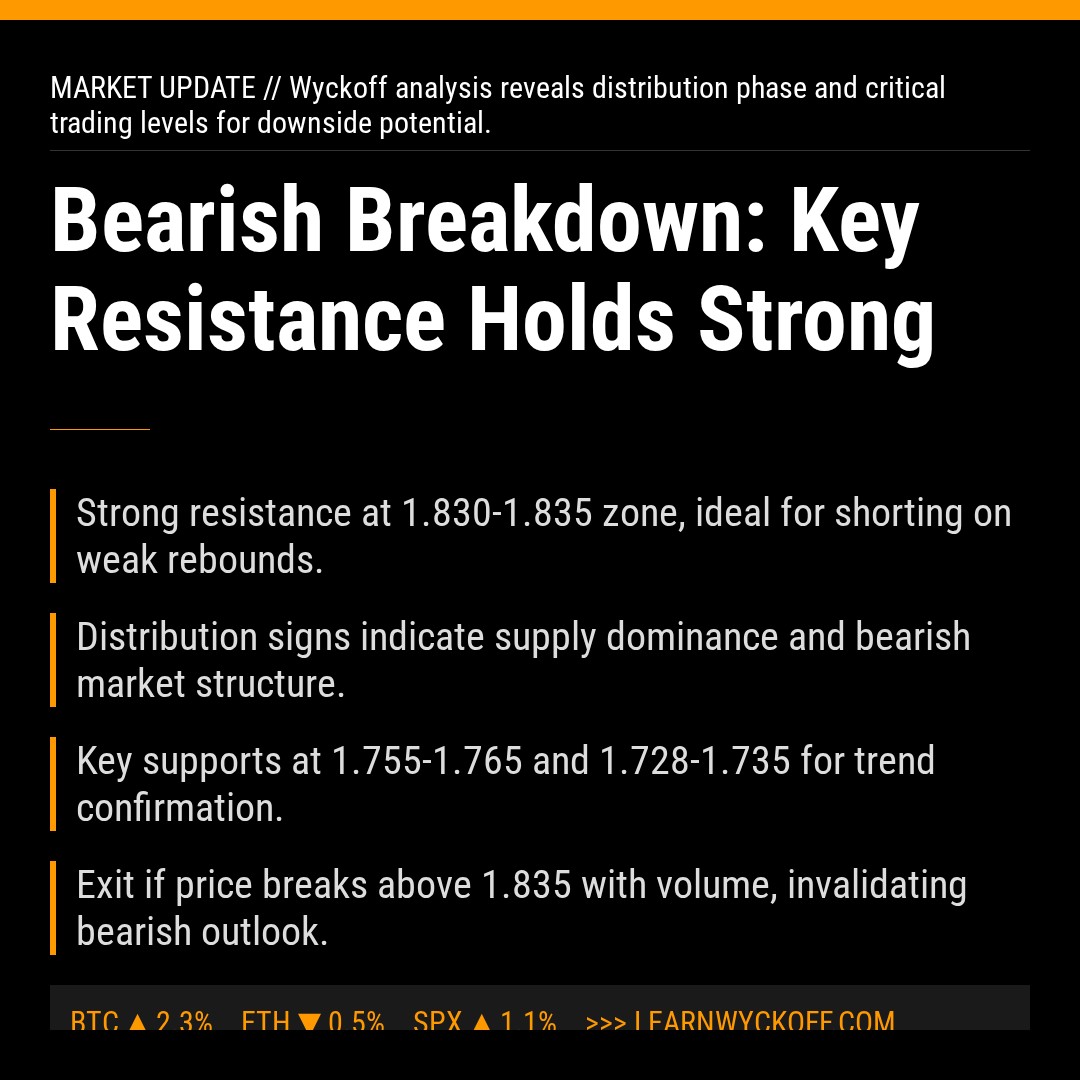
    • Strong Resistance Zone: 1.830 - 1.835. This is the resistance band formed by the January 6th rebound high and the November 10th high, also the point where the recent rally failed. Any rebound approaching this zone with diminishing volume is a potential shorting opportunity.
    • Secondary Resistance / Recent Highs: 1.810 - 1.827. The supply zone formed on January 7th-8th.
    • Key Support Levels:
      1. 1. 1.755 - 1.765 Zone: The consolidation platform from late December 2025, also near the current 60-day MA.
      2. 2. 1.728 - 1.735 Zone: The December 2025 low. A break below would confirm a deepening downtrend.
      3. 3. 1.710 - 1.720 Zone: The launch platform from early November 2025 and the long-term moving average support zone.
  • Comprehensive Trading Signals:
    • Primary Signal: Bearish. The market structure shows distribution characteristics, supply-demand dynamics have shifted to supply dominance at highs, and the short-term trend has weakened.
    • Operational Recommendations:
      • Aggressive Shorting: If the price rebounds to the 1.810-1.820 zone and shows signs of stagnation (e.g., upper shadows, divergence between price and volume) on a 15-minute or hourly chart, consider a light short position. Initial stop-loss placed above 1.835.
      • Conservative Shorting / Add-on Point: A price break below 1.765 (recent minor platform support) or 1.728 (previous low support) can be considered confirmation of the downtrend, allowing for follow-up short positions. Stop-loss set above the high of the breakout candle.
      • Observation / Exit Conditions: If the price breaks above and holds above 1.835 with strong volume, the bearish logic is invalidated. Exit positions and observe.
  • Future Validation Points:
    1. 1. Confirmation Signals: Subsequent price action consistently remains below 1.810 and gradually tests the 1.765 and 1.728 supports. Rebounds exhibit "low volume, weak" characteristics.
    2. 2. Invalidation Signals: Price finds strong support near 1.765 or 1.728, showing "low-volume decline halt" followed by "high-volume bullish breakout" with healthy volume expansion. This may signal the end of distribution and the beginning of a new accumulation phase, requiring re-evaluation.

Disclaimer: The content of this report/interpretation is solely market analysis and research based on publicly available information and does not constitute any investment advice or operational guidance. The author strives for objectivity and fairness but makes no guarantees regarding accuracy or completeness. Markets involve risks; invest with caution. Any investment actions based on this report are taken at your own risk.


Thank you for your attention! Wyckoff volume-price market interpretations are released daily before the market opens at 8:00. Please feel free to comment and share; your recognition is crucial. Let's work together to understand market signals.