As a quantitative trading researcher proficient in the Wyckoff Method, I will, based on the data you provided, write a comprehensive, in-depth quantitative analysis report for product code 399935.
Wyckoff Quantitative Analysis Report for 399935
Report Generation Date: January 8, 2026
Analysis Date Range: November 10, 2025 - January 8, 2026
Core Objective: Identify market supply-demand dynamics and large investor intent based on price-volume data, and provide actionable trading signals.
1. Trend Analysis & Market Phase Identification
As of January 08, 2026, the target 399935 had an open price of 6793.60, a close price of 6803.63, a 5-day moving average of 6627.52, a 10-day moving average of 6511.55, and a 20-day moving average of 6368.28. The daily change was -0.08%, weekly change 6.01%, monthly change 6.01%, quarterly change 6.01%, and yearly change 6.01%.

Conclusion: The market has strongly reversed from the mid-term downtrend from November 2025 to early December, entering a clear bullish uptrend, and may be in a transition phase between a major advancing wave and early distribution.
Data Derivation:
- • Moving Average Alignment: As of January 8, 2026, the price (CLOSE: 6803.63) has successfully broken above all key moving averages, forming a standard bullish alignment (MA_5D > MA_10D > MA_20D > MA_30D > MA_60D). The widening gap between MA_5D (6627.52) and MA_20D (6368.28) indicates strong short-term upward momentum.
- • Trend Reversal Confirmation: Reviewing the data, the market experienced a sharp decline from November 10 to 21, 2025 (approx. -10.7% drop), with prices falling below all short and medium-term moving averages. Subsequently, consolidation occurred in December, followed by a rally starting in late December. The key confirmation signal was the high-volume, long bullish candlestick on January 5, 2026 (+3.75%), which strongly broke above the previous consolidation range and all moving average resistance.
- • Wyckoff Phase Identification: The high-volume decline in November can be viewed as a Panic Selling event or a decline following Distribution. The low-volume, narrow-range consolidation and mild rebound in December align with characteristics of Accumulation or Re-accumulation. The consecutive high-volume breakouts in early January mark the market's entry into the Markup phase. Currently, given that prices have risen near a decade-high level (see historical ranking) and signs of high-volume stagnation are emerging, caution is warranted as the market may be starting to build a Distribution structure.
2. Price-Volume Relationship & Supply-Demand Dynamics
As of January 08, 2026, the target 399935 had an open price of 6793.60, a close price of 6803.63, a volume of 7126142400, a daily change of -0.08%, a volume of 7126142400, a 7-day average volume of 6555845571.43, and a 7-day volume ratio of 1.09.

Conclusion: The supply-demand relationship has fundamentally reversed. Demand entered overwhelmingly in early January, but recent high-volume stagnation suggests supply is beginning to emerge at historical highs.
Data Derivation:
- • Demand-Driven Rally (Strong Signal):
- • January 5 & 6, 2026: Classic "price up, volume up." Prices rose significantly by 3.75% and 1.84% respectively, with volume (VOLUME) reaching 68.6B and 96.6B, substantially above the prior average level. The VOLUME_AVG_7D_RATIO was as high as 1.40 and 1.85 respectively (ranking 19th in the past decade on Jan 6), and VOLUME_GROWTH was 30.1% and 40.9% respectively. This clearly indicates large-scale buying (demand) actively pushing prices higher.
- • Signs of Supply Emerging (Warning Signal):
- • January 7 & 8, 2026: Signs of "high volume without significant price appreciation" emerged. On January 7, the price rose only 0.41% while volume remained high at 87.1B (VOLUME_AVG_7D_RATIO: 1.47). On January 8, the price decreased slightly by -0.078%, with volume still at 71.3B (VOLUME_AVG_7D_RATIO: 1.09). This inability of high volume at relatively high price levels to drive significant price appreciation aligns with the Wyckoff concept of Expansion of Supply or an Initial Distribution Signal, indicating selling pressure (supply) is strengthening at current levels.
- • Historical Extremes: Historical ranking data shows that the ratio of January 6th's volume to the 14-day and 21-day average volume (1.97, 1.93) ranked 15th and 20th in the past decade, respectively. This confirms that the volume surge in this rally is an abnormal, historically significant amplification, not retail-driven, but a clear trace of large capital activity.
3. Volatility & Market Sentiment
As of January 08, 2026, the target 399935 had an open price of 6793.60, a 7-day intraday volatility of 0.23, a 7-day intraday volatility ratio of 1.14, a 7-day historical volatility of 0.28, a 7-day historical volatility ratio of 1.05, and an RSI of 68.83.

Conclusion: Market sentiment has rapidly shifted from pessimistic panic in November to optimistic euphoria in January. Short-term sentiment indicators have entered overbought territory, but extreme panic-driven volatility spikes have not yet appeared.
Data Derivation:
- • Volatility Changes: During the November decline, HIS_VOLA_60D (60-day historical volatility) remained high at 0.48-0.50, and PARKINSON_VOL_60D (60-day intraday volatility) was around 0.37, indicating a high-volatility, anxious market state. Upon entering the January rally, long-term volatility metrics have started to decline (HIS_VOLA_60D: 0.347, PARKINSON_VOL_60D: 0.263), showing market sentiment stabilizing after the trend establishment. Short-term volatility ratios (e.g., HIS_VOLA_RATIO_7D_14D) are around 1.05, indicating short-term volatility is slightly higher than mid-term, a characteristic of a healthy rally.
- • Sentiment Indicator (RSI): RSI_14 climbed steadily from a low of 32.14 (oversold) on November 21 to 69.17 on January 7, slightly retreating to 68.83 on January 8. The current RSI has entered the overbought zone (>70 is extreme overbought), indicating significant short-term exhaustion of upward momentum, euphoric market sentiment, and increased pressure for a pullback.
4. Relative Strength & Momentum Performance
Conclusion: The target's short-term momentum is extremely strong, showing strong relative strength across all observed timeframes, acting as a leading force in the market rally.
Data Derivation:
- • Momentum Trend: All momentum return metrics have recently turned from negative to positive and surged sharply.
- • WTD_RETURN (Weekly Return): +6.01% (as of Jan 8), indicating extremely strong short-term momentum.
- • MTD_RETURN (Monthly Return): +6.01% (only 5 trading days in January), showing explosive force at the month's start.
- • QTD_RETURN (Quarterly Return) & YTD (Year-to-Date Return): Both rapidly reversed from -6.66% on December 31 to +6.01%, indicating this rally has completely overturned the previous medium-term weakness.
- • Momentum Validation: The strong momentum data, combined with the high-volume breakout price action and bullishly aligned moving average trend, confirms the validity and strength of the current uptrend.
5. Large Investor ('Smart Money') Behavior Identification
Conclusion: Large investors engaged in patient accumulation towards the end of the November-December decline and during the consolidation phase, then initiated a rapid markup rally in early January. Currently, near historical highs, there are signs of initial distribution behavior.
Data Derivation:
- • Accumulation: The high-volume decline in late November (e.g., the 21st), combined with historical ranking data showing "the highest 60-day average volume range in the past decade," indicates substantial share exchange during panic. The subsequent low-volume, narrow-range consolidation in December is typical behavior of smart money controlling costs and continuously absorbing shares.
- • Markup: The historically significant high-volume rally on January 5-6 represents smart money, after completing accumulation, using substantial capital to rapidly distance from the cost zone and attract market followers, aiming to quickly establish a new uptrend.
- • Initial Distribution: The emergence of "high-volume stagnation" on January 7-8 is a critical signal. After driving prices to significant psychological and technical resistance levels (e.g., near-decade highs), smart money begins providing liquidity (selling) to the euphoric market, testing its absorption capacity. This is a behavioral pattern shift requiring high vigilance.
6. Support/Resistance Level Analysis & Trading Signals

Conclusion: The market is at a critical decision point. The short-term trend is bullish, but chasing the rally carries high risk. A "buy on pullback" strategy is recommended over chasing highs, with close monitoring for confirmation of distribution signals.
Key Price Levels:
- • Immediate Resistance: 6899.89 (January 8, 2026 high, ranking 10th in the past decade). A break above this level would open space for a move towards historical extremes.
- • Core Support / Trend Lines:
- • Strong Support: The 6700-6750 zone (consolidation platform post-breakout on Jan 5-7 and near MA_5D). This zone is the short-term bullish lifeline; holding it indicates a healthy uptrend.
- • Critical Support: The 6500-6550 zone (December highs, the starting point of the early January breakout, and the confluence area of MA_10D/MA_20D). A break below this zone would suggest potential disruption of the current uptrend, requiring reassessment of market structure.
- • Ultimate Support: The 6200-6300 zone (upper boundary of the December accumulation range). A pullback to this level would present an ideal opportunity for a secondary position.
Comprehensive Trading Signals & Operational Recommendations:
- 1. Primary Signal: Cautiously bullish, awaiting a healthy pullback. The market is in an uptrend but is short-term overbought and showing distribution signs.
- 2. Operational Recommendations:
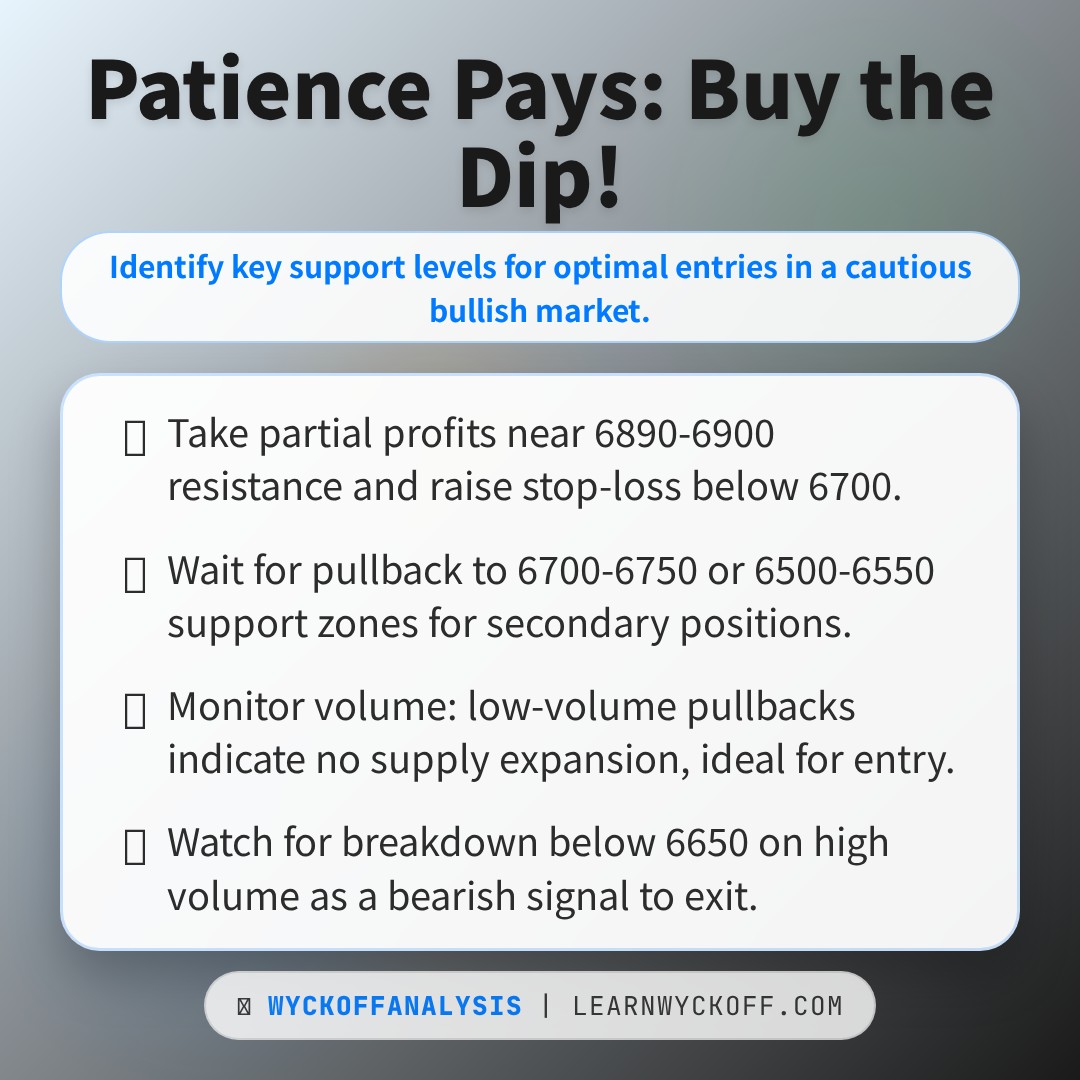
- • For Existing Holders: Consider partial profit-taking near the 6890-6900 resistance zone and raise stop-loss levels to below 6700. Maintain remaining positions to capture potential breakout gains.
- • For Cash Holders / Those Seeking to Add: Strictly avoid chasing highs. Patiently wait for a price pullback to the 6700-6750 (strong support) or 6500-6550 (critical support) zones. Observe volume during the pullback: low-volume pullback (VOLUME_AVG_7D_RATIO < 0.8) is preferable, indicating no expansion of supply and presenting an opportunity for demand re-entry.
- • Observation / Risk Control Point: If the price breaks below 6650 on high volume (volume ratio >1.2) with weak intraday rebounds, it may signal accelerated distribution by smart money; consider exiting to observe.
- 3. Future Validation Points:
- • Bullish Confirmation: If price finds support in the 6700-6750 zone and subsequently breaks above 6900 with a high-volume (VOLUME_AVG_7D_RATIO >1.2) strong bullish candlestick, it would confirm the continuation of the uptrend.
- • Bearish / Distribution Confirmation: If price oscillates repeatedly below 6900, forming multiple "upthrust" candlesticks (long upper shadows) accompanied by sustained high volume (VOLUME_AVG_7D_RATIO consistently >1.0), followed by a price break below 6700 without a quick recovery. This would constitute a standard Wyckoff distribution structure, signaling the start of a medium-term correction.
Risk Notice: This report is based on historical data and Wyckoff principles and does not constitute direct investment advice. Markets carry risks, invest with caution.
Disclaimer: The content of this report/analysis is solely market analysis and research based on publicly available information and does not represent any investment advice or operational guidance. The author strives for objectivity and fairness in the content but makes no guarantees regarding its accuracy or completeness. Markets carry risks, invest with caution. Any investment actions based on this report are taken at one's own risk.
Thank you for your attention! Wyckoff price-volume market insights are released daily before the 8:00 AM market open. Please feel free to leave comments and share. Your recognition is crucial. Together, let's see the market signals.
Member discussion: